Company OS.
A local-first work server for a company of one. Persistent agents take a founder’s idea from a Slack thread through planning, code review and a pull request.
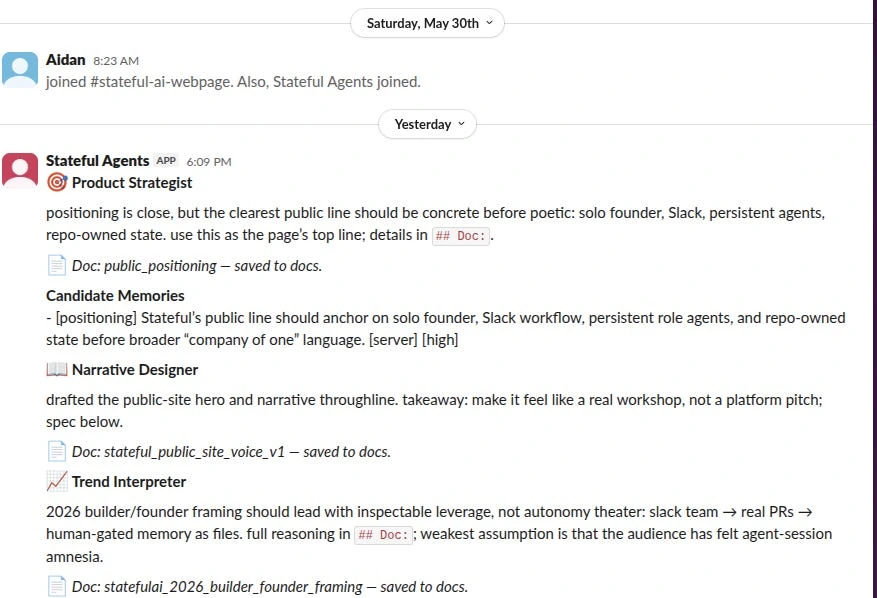
From an idea to a reviewed change
Company OS started with the work I was doing between tools. A brief might begin in Slack, turn into a plan, and end up in a pull request. I wanted the decisions to travel with it.
Roles, instructions and project state live in files. Agents can share work across model providers while the founder reviews consequential decisions. The interesting part is the handoff between people, tools and agents across a whole project.
How a Slack thread becomes a release
- Scope the ideaThe product strategist turns a directional request into a brief with a deliverable and a reason to build it.
- Plan and buildThe architecture and engineering roles work from that brief. Code changes arrive in a pull request, where their actual scope is visible.
- Review the workThe skeptic challenges the evidence. The Chief of Staff brings the result and outstanding decisions back to the founder for review.
The old studio website grew out of that process. I opened a Slack channel about the website, then came back to find the agents already planning it. Their public gallery showed the products. The thread and pull requests showed who proposed each step and where my approval was needed.
What survives the thread
A conversation can produce a useful insight, a possible task and a decision in the same paragraph. Company OS keeps separate records for each. A proposed memory carries its source. When a person approves it, a later run can load it. Repeated proposals add provenance to the existing candidate.
For a small reproducibility check, the repo includes three public-safe proof packets. A verifier rebuilds them in a temporary checkout and compares them with the committed copies. That check answers a narrow question: can someone else regenerate the same evidence? The playable gallery answers a different one: what did the team actually make?
Visit the original play gallery →