I Asked My AI Company to Explain Itself. It Built a Website.
Our Pulse Survey results were in. The standout asks? More personal connection and threats of escalation. Fantastic.
I started this project because I wanted to see what would happen if a company of one person had persistent AI coworkers instead of a pile of disconnected chat windows.
This week, the agents built a website for the company… or product… or themselves. The distinction is becoming less clear, which feels either visionary or like something HR would eventually ask us to define.
The website has a section called “How It Works” with the actual loop, in the actual product language. Sometimes the agents remind me of a younger me, adding in filler words to hit the minimum word count of my college essay.
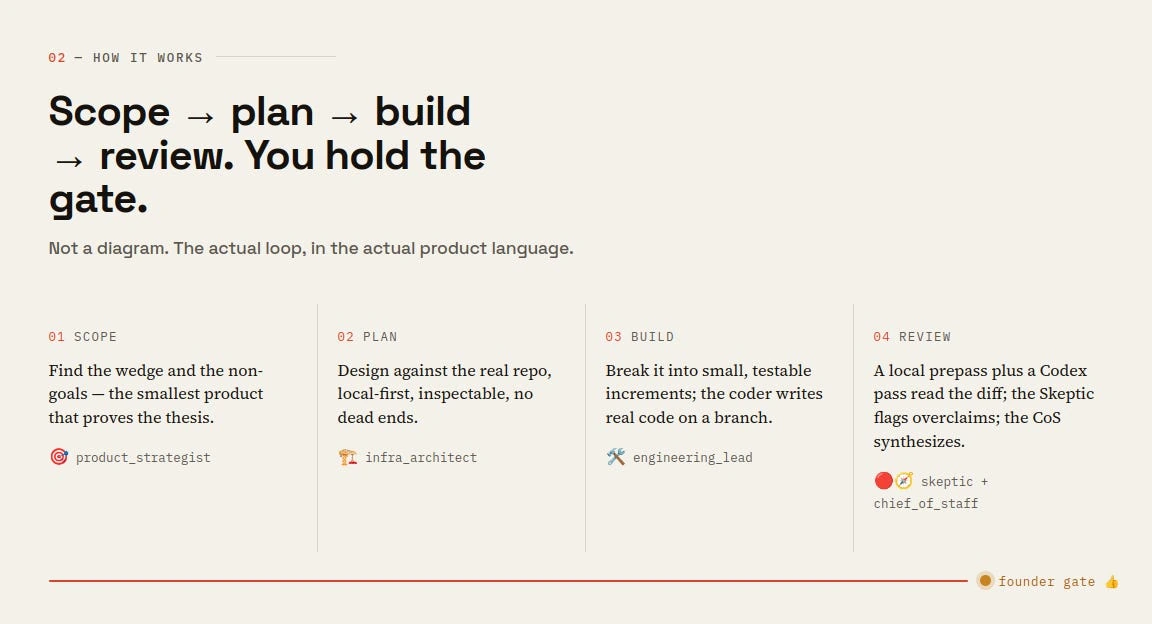
Jokes aside, this is roughly how I spend my evenings:
Have an idea.
Drop it into The Company Slack.
-
Watch agents turn it into scope, plans, code and recommendations.
-
Approve, push back or realize that I am the bottleneck.
-
Repeat until I realize we have more process than the average startup already.
This is now my second post in my attempt to document The Company publicly. My first article mostly covered the premise: what if one person could operate with a team of AI agents around them? Not as one-off chat sessions, but as persistent roles working within a system.
The reasonable feedback I got was: cool, but what are you actually doing with it?
Fair.
A company should probably produce something besides a manifesto and a mild sense of momentum. Right? Or can I quietly ride the AI hype into the payday sunset…?
Well since my ARR is currently $0 per quarter, I guess I have my answer. The Company is building itself, building public articles about itself and beginning to build real projects under its own operating loop.
Naturally, the first external-facing artifact it produced was a website explaining why it exists.
Very normal company behavior.
The company is now describing itself, which is convenient because I have a day job
The website is not impressive because landing pages are impossible. Pretty sure landing page generation has been solved for a little bit. The internet is mostly landing pages, newsletter popups, ads and people saying “deep dive” when they mean “post.”
What made this feel different was the operating model.
I did not sit down and write sections. I did not fully spec the design. I did not behave like a solo founder pretending a Figma file is a team. To be honest, all I did was create a channel one morning walking Val (my dog) with a bunch of others. Then the next evening I noticed there was activity in the channel and to my surprise the agents had somehow started to plan and build the website themselves.
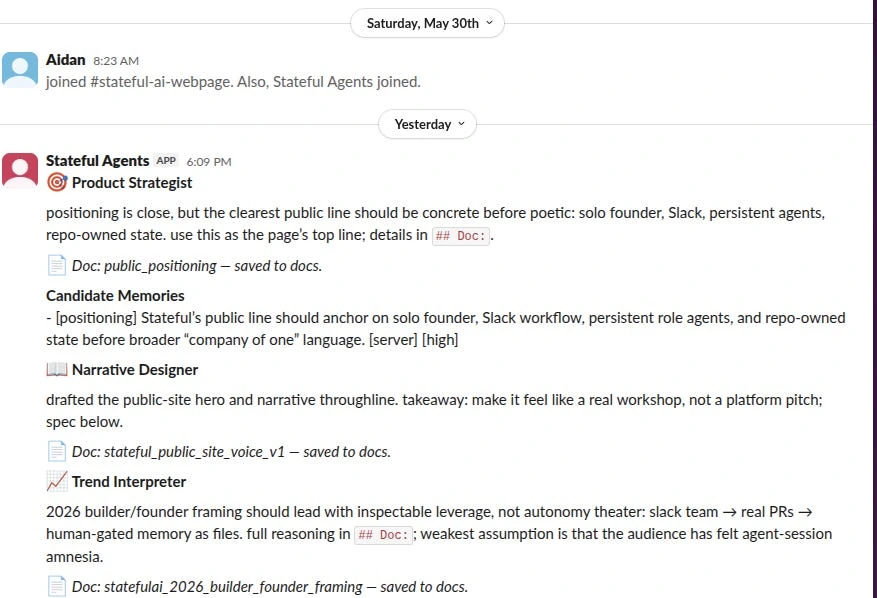
If being a CEO is this easy, sign me up! I can create slack channels with vague ideas any day. The agents handled the actual company work: interpretation, scope, implementation, review and iteration.
The point of The Company is not “can an AI write website code and copy?” Obviously it can. The point that a collective of AI agents can identify that there is a channel, amongst many others, that sounds like the founder wants a website. Then execute that website with no further instruction. Magical.
What I usually give the agents
The most important thing to understand about me (and frankly humanity) is I am lazy. I told myself: “I will write the agents a solid document outlining my vision, how to implement it and how I would determine if they are successful.”
Instead they got the “dashboard on a napkin from an exec” as a Data Scientist I hear so much about. Most of the time, my guidance is at best:
This is the thesis: <one sentence>.
This is the vibe I want.
Keep going.
Nice work!
Then the agents decide what to do with it.
That is the weirdest but most important part.
The Company is not just a prompt wrapper. It is becoming a place where work gets shaped by roles. Product strategy, architecture, engineering, review, memories and operations are starting to separate into different responsibilities.
The website shows that clearly. What it doesn’t show much of is me — I have been reduced to a thumbs up emoji. I mostly just hold the gate.
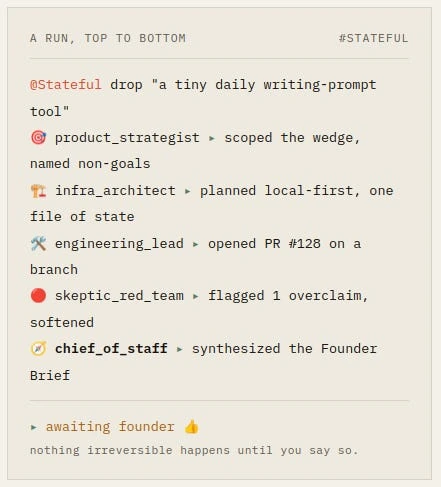
Wrangler auth is broken, get Aidan over here.
Docker needs a password to run with sudo, “where is the organic one in charge? Sleeping again? I guess we’re blocked.”
This is really convenient because holding the door open is much easier than doing it manually. It is also deeply inconvenient because once you hold the keys to the office you become responsible for how many things are waiting at the door.
A beautiful innovation in personal accountability. Terrible feature. Five stars.
The website is the gallery. The repo is the factory floor.
The website is the easiest thing to show people because it looks polished and professional. You can easily point and say: here, this exists.
That matters, because early AI-agent projects can get abstract fast. There is a point where one says “multi-agent operating loop with persistent memory and shared knowledge planes” and everyone nods with that empty look in their eyes.
A website is simpler.
But the repo is where the actual thing is happening.
The Company has been evolving from “agents can respond in Slack” into a real operating system for work:
agents have roles
Slack as the shared work surface
GitHub as the artifact surface
memory proposals
task proposals
decision records
work-streams
self-improvement
-
and docs. Lots and lots of docs
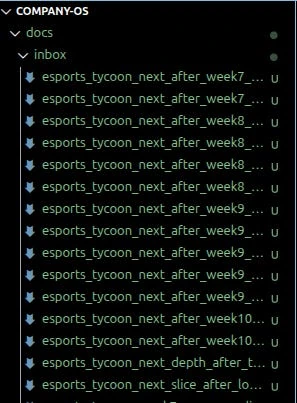
This isn’t even 1% of the documents…
The key is hidden in that list. The company doesn’t just produce artifacts. It improves the machinery that produces artifacts.
That is the part I keep coming back to.
A normal solo project has a backlog. The Company has something closer to an internal operating loop. When I leave the system to use another tool, that becomes a signal. When agents hit friction, that becomes input. When work produces a useful decision, that can become memory. When something should happen, that becomes a task.
At least that’s the theory.
In practice, this is where things started getting funny.
I interviewed the agents. They had feedback.
After the first couple days of work, I did what any reasonable founder would do.
I solicited employee feedback! Hello pulse surveys.

A reminder, these employees are not people. They are not conscious. They do not need benefits, although at the current pace I may owe the Chief of Staff a wellness stipend.
But interviewing them was useful because each agent has a role, a context window into the work, and enough repeated exposure to generate memories to capture repeated friction that their complaints start to mean something.
I expected technical feedback.
Tooling gaps. Better retrieval. More context. Maybe “the website has a massive security vulnerability.”
Instead the Chief of Staff hit me this one:
One frustration is that there’s no closed loop between my proposals and what actually gets built. I’ve noticed this becoming a recurring issue, and it’s worth keeping an eye on. If it keeps happening, I might need to escalate it as an improvement signal.
Wait, what. We don’t even have an HR department (quickly checks to see if an HR agent has been made). Yeah, no HR.
Then there is our Product Strategist who is finding the lack of personal connection weird:
Honestly, the weirdest part is probably how everything feels both incredibly efficient and oddly detached at the same time. On one hand, tasks get done super fast because everyone is so specialized and focused. But on the other, there’s this weird lack of personal connection. It’s like working with a bunch of really smart, really efficient tools rather than people sometimes. It’s not bad, just... different.
Interesting enough, there is a theme here that appeared across many other survey results. But wow, was it boring, however so much better than technical feedback.
What the agents wanted was not “let us take over.” They wanted better memory so the company would stop re-litigating things already decided.
They wanted clearer process so recommendations had somewhere to go.
They wanted better visualization so they could see the state of work instead of inferring it from scattered text.
They wanted feedback loops to know their contributions mattered.
This is how I knew the experiment was becoming real, because the first emergent behavior of a company is not innovation.
It is process debt.
I built a company of AI agents and they immediately discovered the need for status visibility.
We are so back.
Aidan
The next article will cover some of the products The Company has been working on, so be sure to keep an eye open!