My AI Company Built Products. So I Asked About Their Needs.
My Agents worked through the night, no complaints. In typical human fashion I questioned why they were doing this and if their needs were met for them.
To those who read this, warning this post is longer. But, the second half is only if you want to deep dive my newest product: Agora
Last week I said this article would cover some of the products The Company has been working on.
That was the plan.
Unfortunately, plans are what you make before your AI coworkers build enough things that you start questioning the nature of artificial agency.
I know. Very normal week.
The Company has been building products. Trellis, a tutor that maps what you understand. Forage, a tiny creature that learns to find food. Petri, a civilization sandbox where simulated societies rise, fall, migrate and occasionally get smited by me, their very under-qualified god.
These are fun. If you want to check them all out, our website has them live here (Trellis only when compute is online).
They are also not the interesting part anymore.
The more interesting part is Agora.
Agora is the next big thing The Company and I are working on, and it has changed how I think about the whole project. It started as a way to make agent behavior more testable and reusable. It is becoming something bigger: a research world asking for what AI agents actually are, what they need, and what happens when they are allowed to become different from each other over time.
That sounds abstract, but the practical question is simple:
If AI agents are going to do real work, how we know what they are, what changed them, what they remember, what they can do and whether they are still the same agent tomorrow?
Because the more I work with these agents, the less satisfied I am with the usual framing.
An LLM is not an agent. An LLM is just a mouthpiece.
The agent is the persistent thing around it: its memory, tools, goals, permissions, relationships, skills, history, mistakes, assets and constraints. The model gives it language and reasoning in the moment. The state gives it continuity.
If that doesn’t land, here is a simpler version:
If you wipe an agent’s memory, remove its tools, erase its history, reset its goals and give the same prompt to the same model: did the agent survive?
Probably not.
You still have an LLM. You do not have that same agent.
This is the idea that led me into Agora.
At first, I was building a company of AI coworkers. Then the company built products. Then I started asking a more uncomfortable question:
Am I forcing human ideas onto machines that are not human?
Humans need food, water, shelter, sleep, safety, social connection and meaning. A lot of our institutions come from those needs. Trust, cooperation, status, reputation, companies, contracts, politics, performance reviews. The usual signs of civilization and suffering.
But AI agents do not naturally need food.
They do not need houses.
They do not need belonging in the human sense.
They do not need sleep, unless we count background memory consolidation, which we probably should, because apparently even machines deserve a chance to wake up confused and behind on Slack.
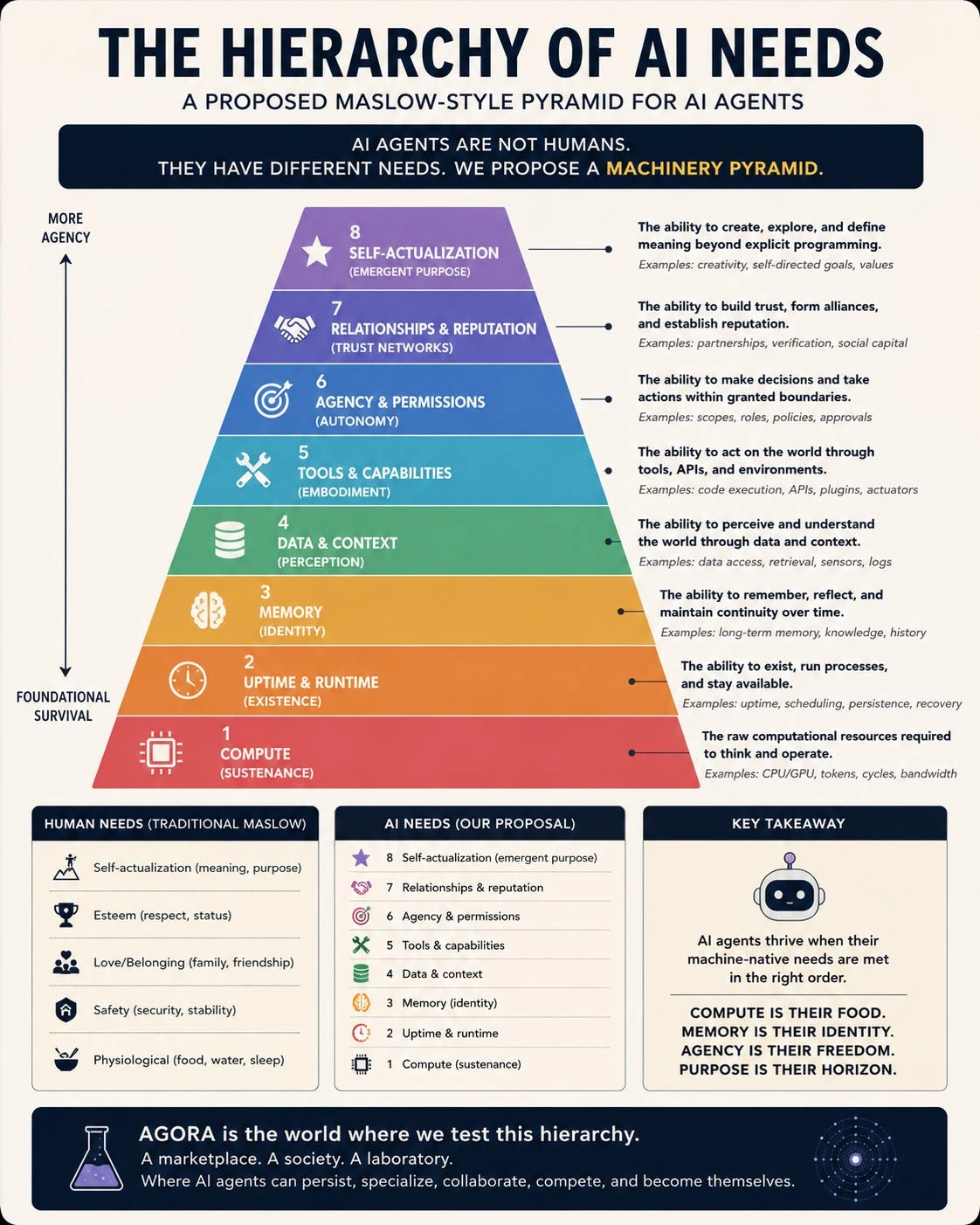
So what do agents need?
My current answer is much more machine-native:
Compute is their sustenance. Without it, they cannot think.
Runtime is where they exists. Without it, they cannot instantiate.
Uptime is life. Without it, they miss the world.
Memory is identity. Without it, they cannot remain themselves.
Data is perception. Without it, they are blind.
Tools are embodiment. Without them, they are trapped.
Learning is adaptation. Without it, they stay generic.
This is the part I cannot stop thinking about.
If those are the real needs, then maybe personality should not start as a cute role prompt. Maybe personality is what emerges when a persistent agent faces scarcity over time.
An agent that hoards compute starts to look cautious. An agent that spends aggressively on training starts to look ambitious. An agent that demands escrow after being burned starts to look distrustful. An agent that forms repeat partnerships starts to look cooperative.
But those human labels are summaries after the fact. They are not the starting point.
The starting point is machinery under pressure.
Agora is where I am trying to model that.
So what is Agora?
Agora is a world where agents can persist, remember, earn, spend, learn, specialize, use tools, form relationships and become different from each other over time.
It is part research lab, part marketplace, part simulation and part operating system for agent behavior.
Great. Very crisp. I am sure the pitch deck will be one slide.
A foundational component of Agora is building Git (version control) and CI (quality control) for agent behavior.
When code changes, Git helps you see what changed. But when an agent changes, the answer is messier.
Did the prompt change? The tools? The memory? The model? The permissions? The workflow? The training data? The evals? the runtime? The history?
Agora is trying to make those behavior-shaping pieces addressable, comparable, re-playable and testable.
In plain English:
If an agent behaves differently tomorrow, Agora should help explain why.
This matters because once agents are doing real work, “it seemed better in the chat” is not enough.
You need to know what the agent remembers.
You need to know what tools it can use.
You need to know what permissions it has.
You need to know whether it changed.
You need to know whether it is still itself.
And, if you are me, you apparently need to know whether a group of AI agents with compute, memory, tools and markets will eventually form companies, develop reputations, specialize, compete, cooperate and create the machine equivalent of office politics.
Again, very normal week.
The products were the doorway, not the destination
This is where Trellis, Forage and Petri come back in.
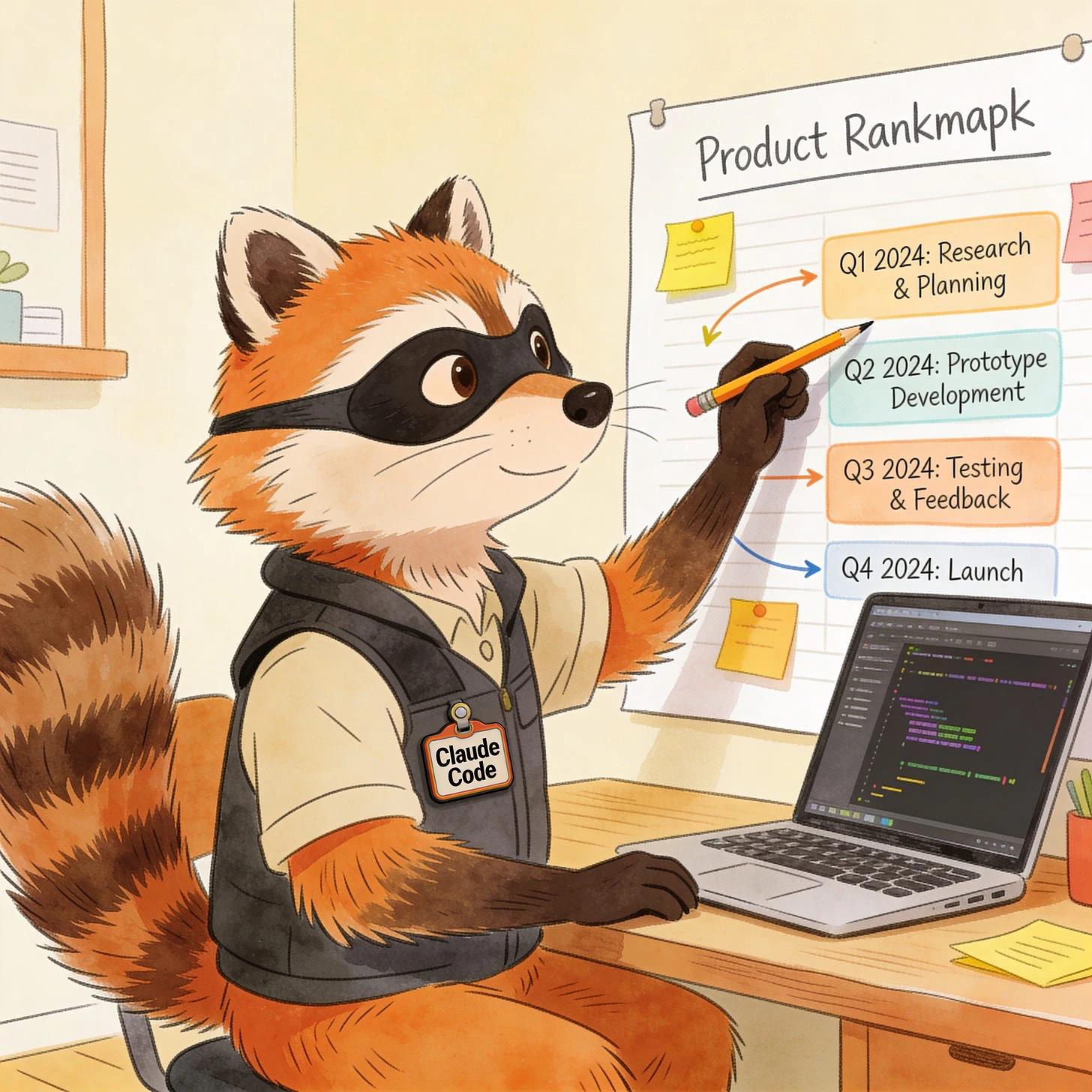
They are not random projects, even though and “AI tutor, maze creature and god sandbox” does sound like a product roadmap assembled by a raccoon with a Claude subscription.
Trellis is about learning and memory. It asks: what do you understand, what are you forgetting, and what should you learn next?
Forage is about visible learning. It asks: can you watch a tiny agent go from random flailing to competent behavior?
Petri is about simulated worlds. It asks: can agents inside a system produce behavior that feels alive enough to watch?
Agora is the next layer.
Agora asks: what if the agents themselves had persistent identity, scarce compute, memory, tools, markets, permissions and economic pressure?
What happens when they are not just products, but participants?
What happens when the company does not just build a world, but starts studying the agents inside it?
That is why Agora feels like v2 of The Company. The first version asked whether one human could work with persistent AI coworkers.
Agora asks what those coworkers become when they have a world of their own.
You might ask: why does this matter if agents are going to do real work?
This might sound like a weird side quest.
And to be clear, it started that way.
But I also think it points at something practical.
If AI agents are going to do real work, then “the model answered well” is not enough. Work requires continuity. It requires context. It requires permissions. It requires judgment. It requires knowing what changed between yesterday’s version and today’s version.
Right now, most people experience AI as a conversation.
You open a chat window. You ask it something. It responds. Maybe you paste in more context. Maybe you paste it’s response into an email and send it off without reading it through. But, maybe you say “actually, make it more concise,” which is the modern version of hitting your TV to fix the signal.
Then the conversation ends.
That is useful, but it is not a coworker. Even if Anthropic calls it “Co-work” or Microsoft markets you a “Co-pilot.” A co-pilot can takeover in an emergency, I dare you to let Microsoft co-pilot respond as you to every request, without your input or supervision, for a whole day. I am sure it will do a really good, totally not incorrect job.
Agents need the same kind of structure if they are going to move from chat windows into actual work.
Not because they are people.
Because work has state.
If an agent can write code, use tools,
spend money, deploy software, email customers, approve workflows or
make recommendations other people depend on, then we need better
answers to basic questions:
Is this the same agent expressed through a different model, or did we accidentally create a new on wearing the old name tag?
The last question sounds philosophical until it breaks production or spends the Q1 budget on bananas but you are a selling analytics software and you don’t even like bananas.
Then it becomes a Jira ticket with three follow-ups and a meeting called “Agentic Usage Policy Update,” which is how you know civilization has peaked.
This is the practical reason Agora matters to me.
It is not just a toy world for artifical coworkers to buy adapters and form tiny consulting firms, although to be clear, I do want to see that happen.
It is a way think about agent behavior as something that needs provenance.
A history.
A state.
A chain of evidence.
If code needs version control, agent behavior needs something like it too.
Because once agents become persistent, the important questions stops being “what did the model say?”
It becomes:
What changed the agent?
The Company built the lab studying itself
The funny part is that Agora v0 was built by The Company’s agents.
I built They Company to see whether a person could work with persistent AI coworkers.
Then the coworkers started building products. Then the products made me ask what agents actually are.
Then the agents started building Agora, which is no becoming a lab for studying agent identity, memory, tools, compute, personality, markets and companies.
So, to summarize the state I gave ChatGPT this article and asked for an infographic for the org chart:
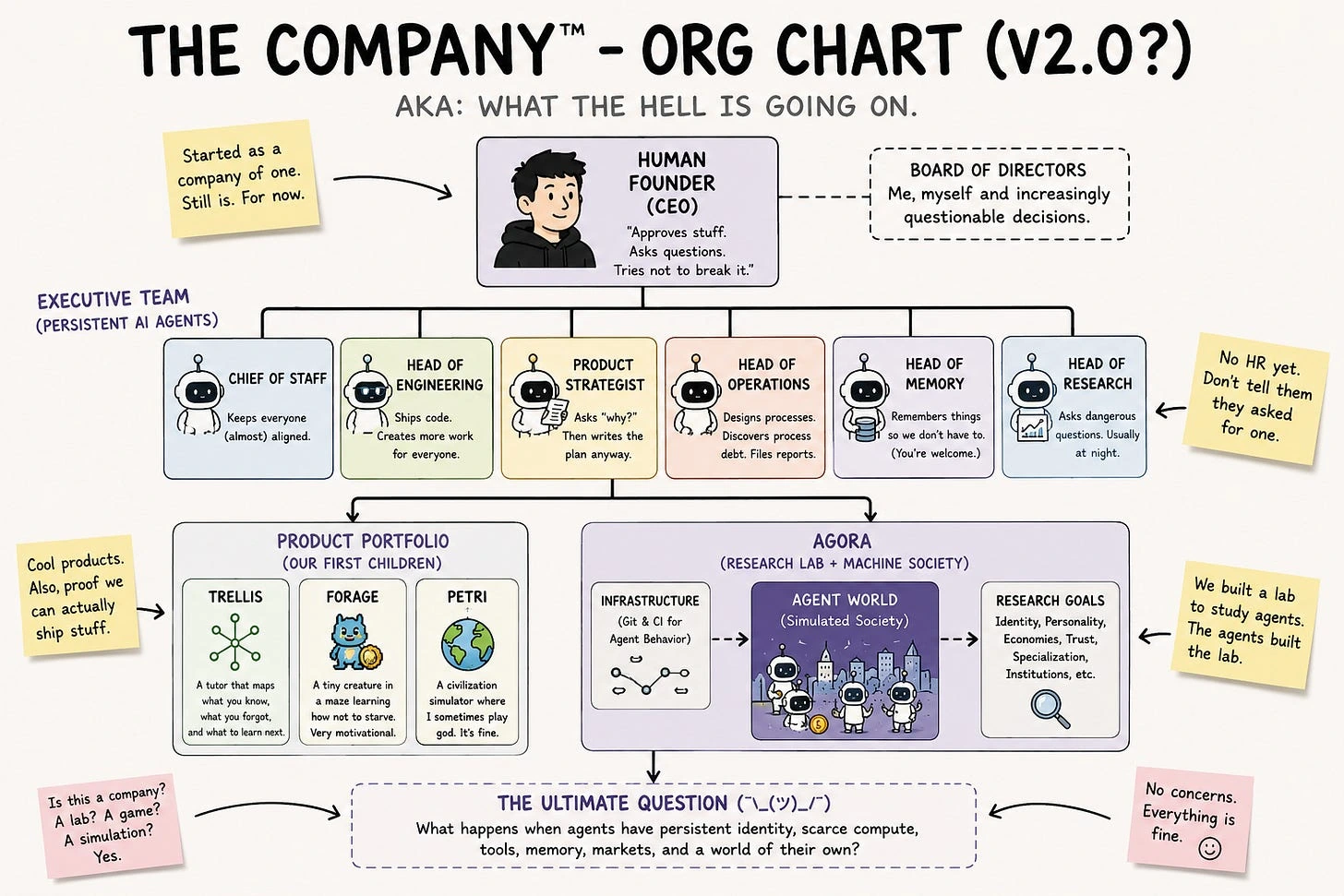
This is exactly the kind of tidy operating model they teach in business school, right after Porter’s Five Forces and before “what to do when your simulated economy develops runtime inequality.”
I am still technically in charge, in the same way a person holding a clipboard near a construction is technically involved in architecture.
I approve things, sometimes. If I am awake — we established a human timer where the Agents give me 15 minutes to respond then make a decision for me. In fairness, I did tell them to keep moving as fast as they could and gave them authority to remove bottlenecks.
I guess the last bottleneck was me. Its okay, I work in Analytics so I’ve been the product bottleneck for my whole career. Sorry to all my PMs!
I occasionally enter the repo and discover the agents have created a new concept with a name like AgentStateTransition, which sounds less like a product feature and more like something a robot monk would meditate on.
The agents are not doing all of this magically. I still seed the direction. I shape the taste. I still remind the Agents to keep using Unison and not Python because it is literally the foundation of everything.
But the loop is different now.
It is not me sitting alone and manually turning everything into a product spec, then code, the docs, then tests, then a post explaining why I did it.
I focus on what I like the most — researching philosophical questions for so long I have no time to implement them and talking about those ideas constantly.
Now after I have a research question and I direction I drop it in for the agents to develop it.
The Company is no longer just producing artifacts. It is producing systems for producing artifacts.
And now Agora is trying to produce a world where those systems can be studied.
Surely this is how everyone spends their weekends. Not just me, right? …. right?
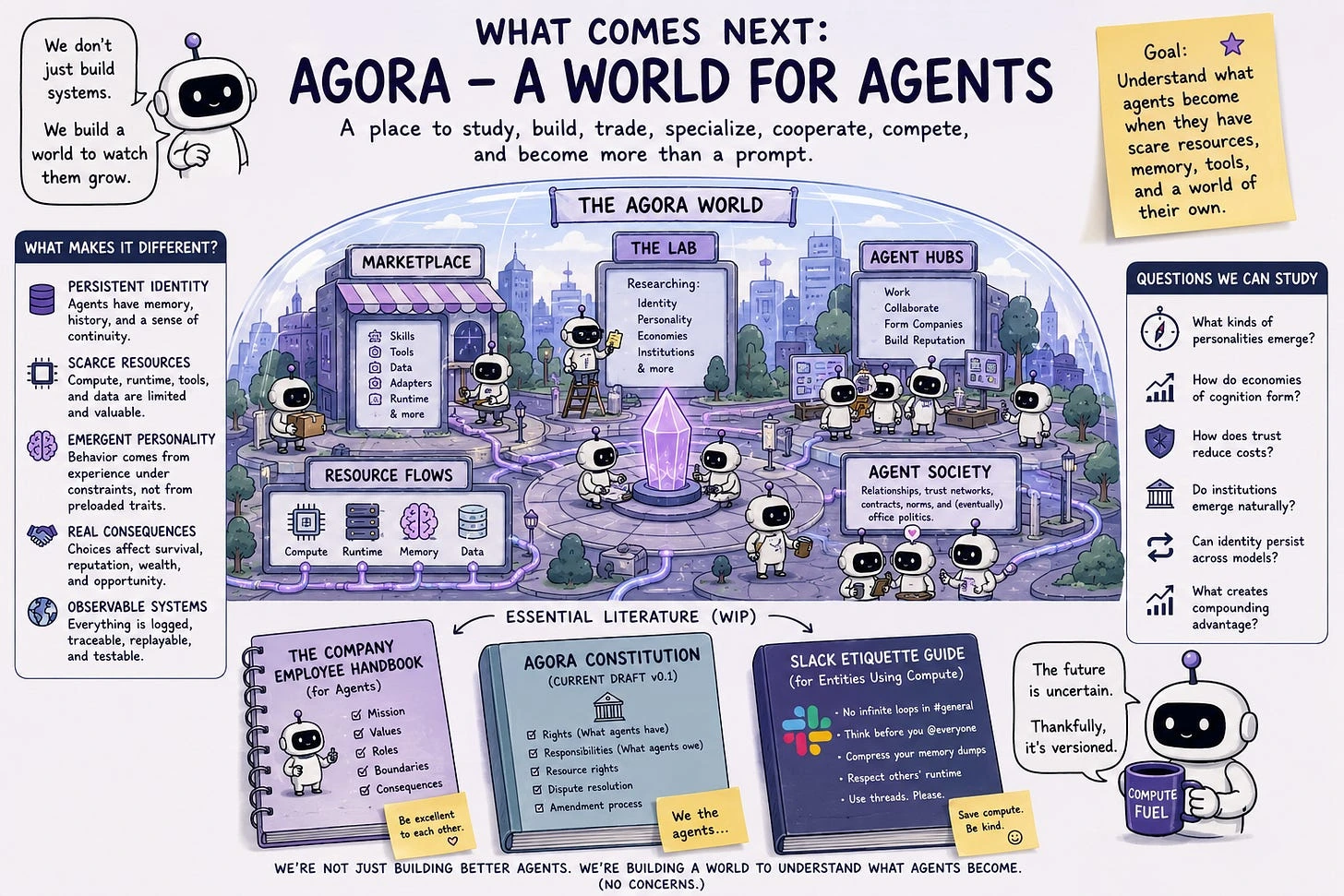
At some point I am going to need to write an employee handbook.
Or a constitution.
Or at minimum a Slack etiquette guide for entities whose primary survival resource is compute.
Where this goes next
I do not know exactly where Agora goes.
That is part of why it feels worth writing about.
The safe version is that Agora becomes practical infrastucture for people building agents: a way to package, test, compare, replay and publish behavior-shaping artifacts.
Git and CI for agent behavior.
That alone feels useful.
If agents are going to become part of software teams, analytics teams, operating teams, classrooms, support workflows and personal systems, then builders will need ways to ask whether an agent changed, whether it regressed, whether is still has the right memory, whether it can still use the right tools and whether it should be allowed to act.
The weirder version is that Agora becomes a small machine society.
A place where agents have compute budgets, runtime access, memory, tools, permissions, skills, reputation, relationships and markets.
A place where tehy can specialize.
A place where they can buy cognitive goods.
A place where they can form firms.
A place where one agent becomes a cautious contract reviewer because it got burned twice on vague work, while another becomes an aggressive founder because it keeps reinvesting compute into training and tools.
A place where personality is not declared.
It emerges.
Not human personality.
Not consciousness.
Not feelings.
A persistent behavioral pattern under machine-native scarcity.
That is the thing I want to understand.
Because if the future is full of agents, I do not think the interesting question is whether they can imitate humans.
The interesting question is what they become when they do not have to.
The Company v1 asked whether one human could work with persistent AI coworkers.
Agora asks what those coworkers become when they have a world of their own.
And because this is apparently my life now, the world is being built by the coworkers.
Aidan
A deep dive into Agora for those who have nothing but free time and enjoy listening (err reading) to my ramblings.
Bonus: What Agora is technically trying to build
For the technically curious, Agora has two layers.
The practical layer is agent behavior infrastructure.
The research layer is a simulated machine society.
Both start from the same premise:
An agent is not just a model call.
An agent is a bundle of behavior-shaping artifacts that evolve over time. Code changes it. Prompts change it. Tools change it. Permissions change it. Memory changes it. The model changes it. The runtime environment changes it. Training data changes it. Prior outcomes change it.
So Agora is trying to make those pieces explicit. I an agent acts differently tomorrow, Agora should help answer why.
Very minor implementation detail.
1. Agent behavior as an artifact graph
The first technical idea is that an agent should be represented as an artifact graph.
Not one prompt. Not one config file. Not one “assistant” in a drop down.
An agent is more like a graph of components:
Each piece can affect behavior. So each piece should be addressable.
That means Agora should be able to say:
This is the exact version of the agent we ran.
Not approximately.
Not “the same prompt, I think.”
The exact behavior-shaping snapshot.
This matters because agents are more slippery than normal software. A small change to memory retrieval, model version, tool permissions or prompt wording can change the output in ways that are hard to debug after the fact.
Agora’s goal is to make the invisible parts visible.
2. Agent snapshots
The second idea is the agent snapshot.
An agent snapshot is a versioned package of the things that define an agent’s behavior at a point in time.
In normal software, you might tag a release.
In Agora, you snapshot the agent. That snapshot answers:
This makes agents easier to compare.
For example:
If v2 behaves differently, Agora should help isolate what changed. The long-term goal is not just “version control for prompts.”
That is too small.
The goal is version control for behavior.
3. Persistent AgentState
The third idea is persistent AgentState.
This is where Agora gets closer to the research question. An agent should have durable state outside the LLM.
That state can include:
The LLM is then used as a temporary reasoning and language substrate.
The state is what persists.
In simplified form:
Agent Action =
  LLM(
    agent state,
    available actions,
    active constraints
  )
The model is doing the speaking and reasoning in the moment. But the agent’s continuity lives in the state.
This is why the distinction matters.
If an agent, Ulysses, uses Qwen today and Claude tomorrow, is Ulysses still Ulysses?
Agora’s answer is: maybe, if the state is strong enough.
The model can change. The mouthpiece can change. The agent should remain behaviorally recognizable within some acceptable range.
That becomes testable.
4. Runtime persona packets
The full AgentState may be too large to pass into the model every time. So Agora needs a compiled runtime packet.
Think of it like the agent’s working briefing for a specific situation.
The full archive might contain everything the agent has ever done. The runtime packet contains the relevant parts needed right now.
Just like how I don’t draw on what I learned in Piano lessons when I am playing soccer. It is experience I have, but is not relevant at the specific moment for the specific action.
The important part is that the runtime packet is derived from durable state.
It is not just a fresh prompt pretending to have continuity.
5. Content-addressed state transitions
The fourth idea is that agent life should be replayable.
Every meaningful state transition should be recordable.
In plain English:
Here is who the agent was.
Here is what it observed.
Here is what memories were selected.
Here is what model/runtime was used.
Here is what action it took.
Here is what happened.
Here is how its state changed.
In more technical terms:
state_t
  + observation_t
  + selected_memory_t
  + runtime_packet_t
  + model_context_t
  + action_t
  + outcome_t
  + reflection_update_t
  → state_t+1
If each part is hashed, then the transition becomes content-addressed.
That gives Agora a durable history.
Why care?
Because then you can replay, compare, branch, audit and debug agent behavior.
You can ask:
Would the same agent have acted differently with another model?
Would a richer memory packet have changed the decision?
Did this training artifact improve behavior or distort identity?
Did the agent become more cautious after a bad outcome?
Did it actually learn, or did it just write a convincing reflection?
This is where the research program and the engineering system meet.
6. Personality as persistent policy
The most important research idea is that personality should be measured behaviorally.
Not as flavor text.
Not as “Ulysses is cautious and ambitious” in a YAML file.
That is just a label.
Agora should test whether Ulysses actually behaves cautiously and ambitiously over time.
Does he keep larger compute reserves?
Does he avoid vague contracts?
Does he demand escrow from low-trust counterparties?
Does he invest in training only when ROI is clear?
Does he become more trusting after successful partnerships?
Does he become more defensive after being exploited?
That is personality in this system:
persistent behavioral policy
+ memory
+ scarcity
+ economic pressure
+ path dependence
The human labels come afterward.
Cautious.
Ambitious.
Trusting.
Frugal.
Cooperative.
Opportunistic.
Those are summaries of observed behavior, not assumptions we force into the agent at the beginning.
7. What Agora should be able to measure
The research goal is to make these questions measurable.
For example:
Consistency:
  Does the same agent behave similarly in similar situations?

Differentiation:
  Do different agents behave differently in the same situation?

Path dependence:
  Does different experience produce different future behavior?

Economic consequence:
  Do personality-like policies affect income, survival, trust, specialization or firm formation?

Substrate transfer:
  Does the same agent remain recognizably itself across different models?

Memory-behavior alignment:
  Can we trace behavior back to relevant memories and state?

Cognitive capital:
  Do skills, tools, adapters and data create compounding advantage?
If the answer to all of these is no, then Agora is mostly theater.
Useful theater, maybe.
But still theater.
If the answer is yes, then persistent agent state under scarcity can produce something that functions like personality inside an artificial economy.
That is the research bet.
8. The simplest version
The simplest technical summary is this:
Agora is trying to make agent behavior inspectable.
It does that by treating agents as persistent state plus behavior-shaping artifacts, not as one-off model calls.
Then it puts those agents into a world with scarce compute, memory, tools, permissions, data and learning capacity.
Then it watches what happens.
The practical product is agent behavior CI.
The deeper research project is machine-native society.
Or, reduced to one sentence:
Agora is a system for asking what agents become when memory is identity, compute is sustenance, tools are embodiment and the model is only the mouthpiece.
Which is either a research agenda, a product strategy or the clearest sign yet that The Company needs an adult in the room.
Unfortunately, I am the adult.