Agent Homebase.
Homebase runs agents on a schedule and keeps a record of what each one knew. When I give feedback, I can test how it would change the next report.
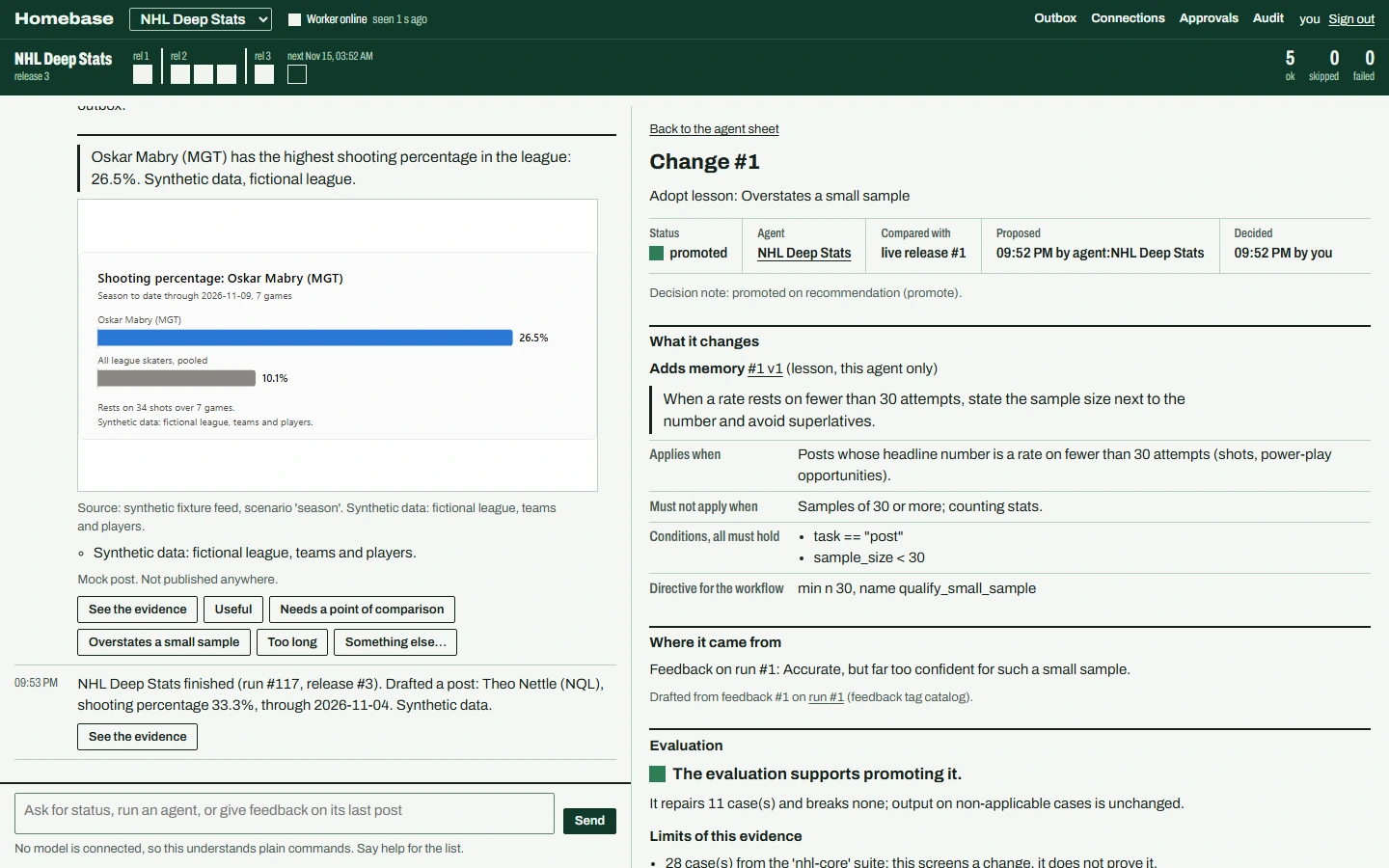
When should a correction carry over?
Suppose a hockey reporter calls a player a breakout star after a handful of shots. I want tomorrow’s report to be more cautious about a small sample. But what happens a month later, when there are enough shots to support the claim? A useful memory needs a record of when its advice applies.
Giving the lesson a fair test
I built an offline demo around 28 synthetic hockey cases. Keeping the rules for when lessons apply fixed 11 previously failing cases and broke none. Removing those rules fixed the same 11 and broke six others. This was a deterministic test of the memory machinery. It gave me specific mistakes to look for when evaluating a model.
- Replay the same casesRun the current and candidate releases on examples that should change, examples that should stay stable, and a protected holdout.
- Inspect repairs and regressionsThe comparison reports which outputs improved and which broke. A polished rewrite of the original example can still fail elsewhere.
- Promote or roll backA person can promote the tested version. The next scheduled run records the memory it received. The previous release remains available for rollback.
What stays running
A manifest names the workflow’s entry command and its limits. A persistent queue handles schedules and interrupted runs. In one hosted check, a worker completed 16 scheduled runs across two redeploys, with one mock post per run. That was a three-hour, 45-minute observation.
Who remembers where a neighbor lives?
Town is Homebase’s life simulation. In one seven-day run, twelve residents made 1,862 decisions. Six had a memory file. Those six were told ten home addresses between them and retained five in their files. Checking what actually made it into memory gave us a more precise question than asking whether a resident seemed to remember.
Watch Ben’s week in Town →